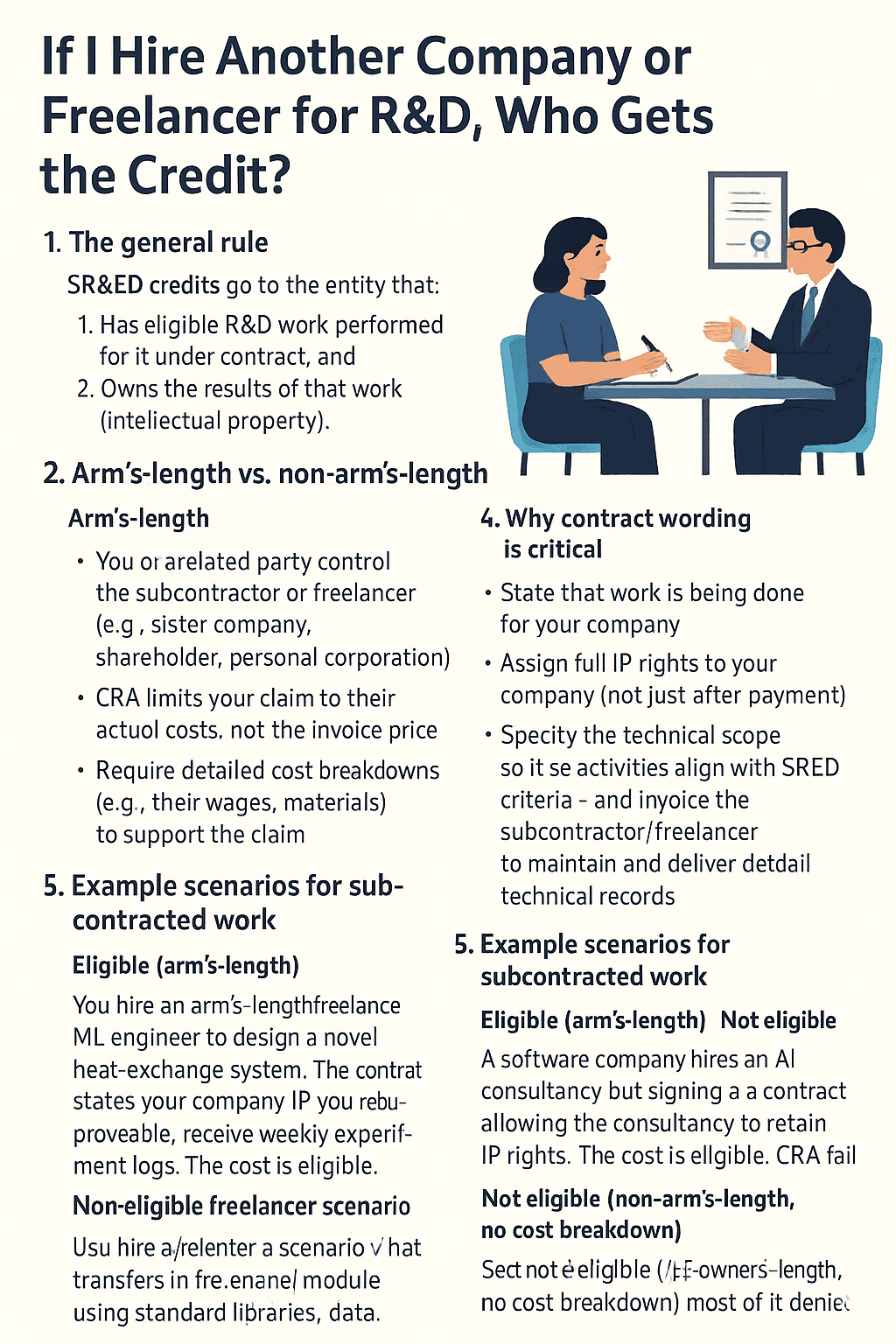
If I Hire Another Company or Freelancer for R&D, Who Gets the Credit?
Learn SR&ED rules for subcontracted work, contractor agreements, and who can claim when R&D is outsourced
If I Hire Another Company or Freelancer for R&D, Who Gets the Credit?
One of the most common points of confusion in SR&ED is who actually gets to claim when R&D work is performed by someone outside your company.
Whether it is an engineering consultancy, a specialized lab, or an independent freelancer, the answer depends on contract structure, ownership of the work, and CRA’s arm’s-length rules.
1. The general rule
SR&ED credits go to the entity that:
- Has the eligible R&D work performed for it under contract, and
- Owns the results of that work (intellectual property, prototypes, data).
If you fund R&D but do not own the results, you cannot claim — even if you paid for the work.
2. Arm’s-length vs. non-arm’s-length
Arm’s-length
- You and the subcontractor or freelancer are independent and have no significant ownership or control relationship.
- You can claim their eligible costs if:
- The work is performed for you
- You own the results
- The costs are reasonable and documented
- The other party cannot claim SR&ED for the same work.
Non-arm’s-length
- You or a related party control the subcontractor or freelancer’s business (e.g., sister company, shareholder, personal corporation).
- CRA limits your claim to their actual costs, not the invoice price.
- You need detailed cost breakdowns (e.g., their wages, materials) to support the claim.
3. Why contract wording is critical
CRA will review contracts to determine if the work was truly performed for you and if you own the results. Your agreement should:
- State that the work is being done for your company
- Assign full IP rights to your company upon creation (not just after payment)
- Specify the technical scope so it’s clear the activities align with SR&ED criteria
- Require the subcontractor/freelancer to maintain and deliver detailed technical records
4. Freelancers: same rules, extra risks
Freelancers are treated the same as subcontractors in CRA’s eyes, but there are some extra pitfalls:
- Many freelancers use contracts that retain IP until final payment, or forever for certain code libraries or design elements.
- Without explicit IP transfer language, CRA may determine the freelancer is the rightful claimant.
- Invoices often mix eligible and ineligible work — you need cost separation to claim correctly.
Example: Eligible freelancer scenario
You hire an arm’s-length freelance ML engineer to experiment with a new algorithm. The contract states your company owns the IP, you receive weekly experiment logs, and the work addresses a technological uncertainty. The cost is eligible.
Example: Non-eligible freelancer scenario
You hire a freelancer to build a product module using standard libraries, the contract does not transfer IP, and the invoice is for a fixed fee with no breakdown. CRA will likely deny the claim.
5. Example scenarios for subcontracted work
Eligible (arm’s-length)
A clean-tech startup hires an independent engineering firm to design a novel heat-exchange system. The contract states the work is for the startup, the startup owns the IP, and the firm provides detailed technical documentation. The startup can claim the $50,000 cost, and the firm cannot claim for that work.
Not eligible (IP ownership issue)
A software company hires an AI consultancy but signs a contract allowing the consultancy to retain IP rights. Even though the company funded the work, CRA rules the consultancy is the rightful claimant.
Not eligible (non-arm’s-length, no cost breakdown)
A med-tech founder’s holding company hires its own wholly-owned subsidiary for R&D, invoices $200,000, and tries to claim the full amount. CRA limits the claim to the subsidiary’s actual cost, and without proper breakdowns, most of it is denied.
6. The takeaway
When R&D is done by another company or freelancer, ownership of results and contract terms determine who gets the SR&ED credit.
If you want to claim, make sure your contracts clearly establish that:
- The work is performed for you
- You own the results and IP
- Detailed technical records are provided
SREDSimplify can help you set up the right agreements and documentation process so you capture every eligible dollar. Try our free pre-screener here: https://sredsimplify.com/
#SRnED #TaxCredits #Innovation #StartupSupport #Engineering #SREDSimplify