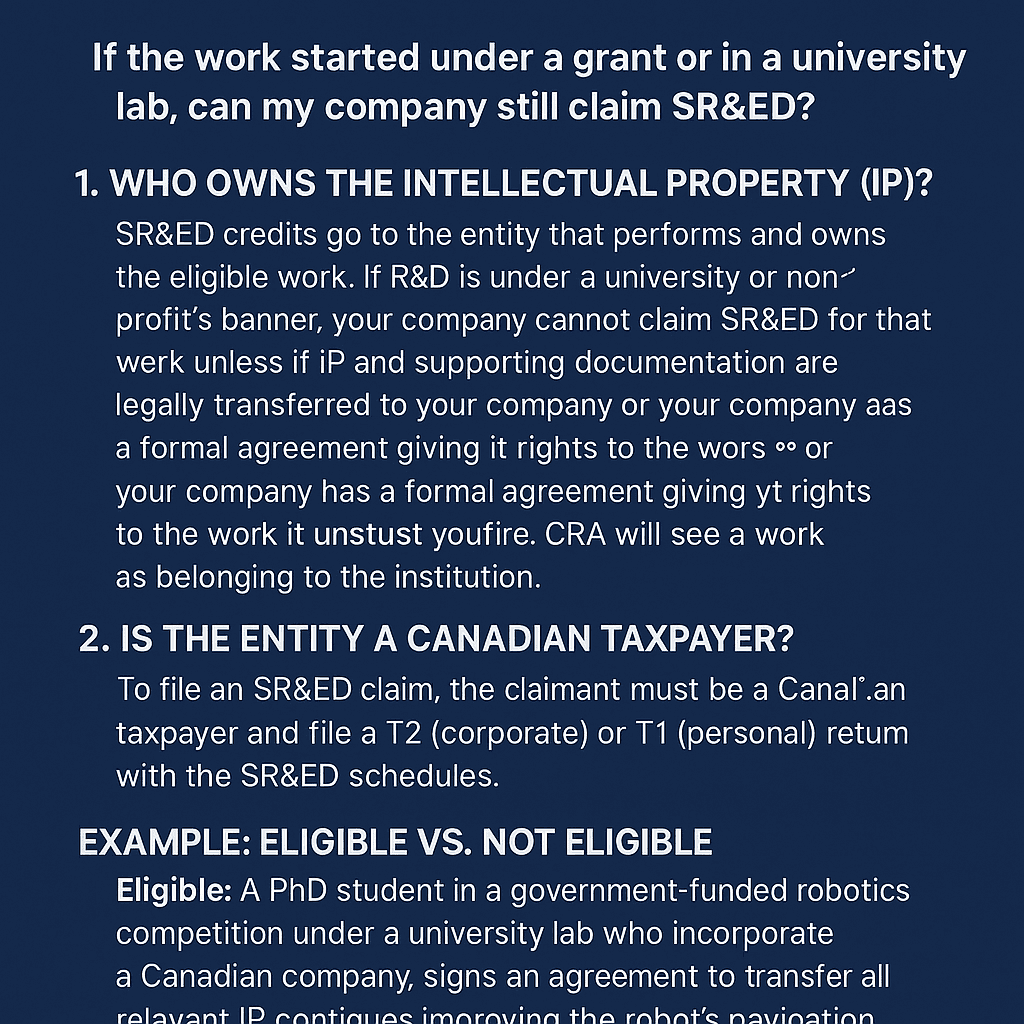
Can You Claim SR&ED for Grant-Funded or Spin-Off Projects?
Understand SR&ED eligibility for university spin-offs and grant-funded projects, including IP ownership requirements
Can You Claim SR&ED for Grant-Funded or Spin-Off Projects?
Many innovative projects start inside universities, research labs, or with grant funding. Sometimes they grow into spin-off companies. A common question we hear from founders is:
"If the work started under a grant or in a university lab, can my company still claim SR&ED?"
The answer depends on ownership, entity type, and how the R&D is structured.
1. Who owns the intellectual property (IP)?
SR&ED credits go to the entity that performs and owns the eligible work. If you are doing R&D under a university or non-profit’s banner, and they own the IP, your company cannot claim SR&ED for that work unless:
- The IP and supporting documentation are legally transferred to your company, or
- Your company has a formal agreement giving it rights to the work it performs.
Without that, CRA will see the work as belonging to the institution, not your corporation.
2. Is the entity a Canadian taxpayer?
To file an SR&ED claim, the claimant must:
- Be a Canadian taxpayer (corporation, individual, or partnership), and
- File a T2 (corporate) or T1 (personal) return with the SR&ED schedules.
Universities and most non-profits are tax-exempt, so they do not claim SR&ED. That means if they own the project and employ the staff directly, no one is claiming the credit — unless a separate taxable entity (like your spin-off) is involved.
3. How to structure grant-funded work for SR&ED
If your project is funded by a grant but performed by your company:
- Ensure the grant agreement allows your company to retain IP ownership or co-own the results.
- Keep detailed technical and financial records showing the work was done by your team.
- If the grant only reimburses expenses, remember that SR&ED is calculated on eligible costs before the grant offset is applied.
4. The spin-off scenario
If you are spinning out of a university or research institute:
- Negotiate an IP assignment or license that gives your company full rights to the R&D you will claim.
- Make sure ongoing development is performed by your company’s employees or subcontractors, not just the institution’s staff.
- Start contemporaneous documentation from day one — CRA will need to see a clear line between the institution’s work and your company’s R&D.
5. Example: Eligible vs. not eligible
Eligible
A PhD student participates in a government-funded robotics competition under a university lab. After graduation, they incorporate a Canadian company, sign an agreement with the university to transfer all relevant IP, and continue improving the robot’s navigation algorithms with their own team. The company can claim SR&ED for the post-transfer work and any pre-incorporation work properly assigned to it.
Not eligible
A team continues to use university lab space and resources for a health-tech project after incorporating, but the university retains IP ownership and pays the staff through its payroll. The company does not have legal rights to the results and cannot claim SR&ED for that work.
The takeaway
Grants and spin-offs can still be part of a strong SR&ED claim — but only if your company owns the R&D work and is the entity performing it. Without clear IP ownership and a proper corporate structure, you may not be able to claim, even if the work is highly innovative.
SREDSimplify helps spin-offs and grant-funded teams quickly assess eligibility and set up proper documentation so they can claim SR&ED from day one. Try our free pre-screener here: https://sredsimplify.com/
#SRnED #TaxCredits #Innovation #SpinOff #GrantFunding #StartupSupport #SREDSimplify