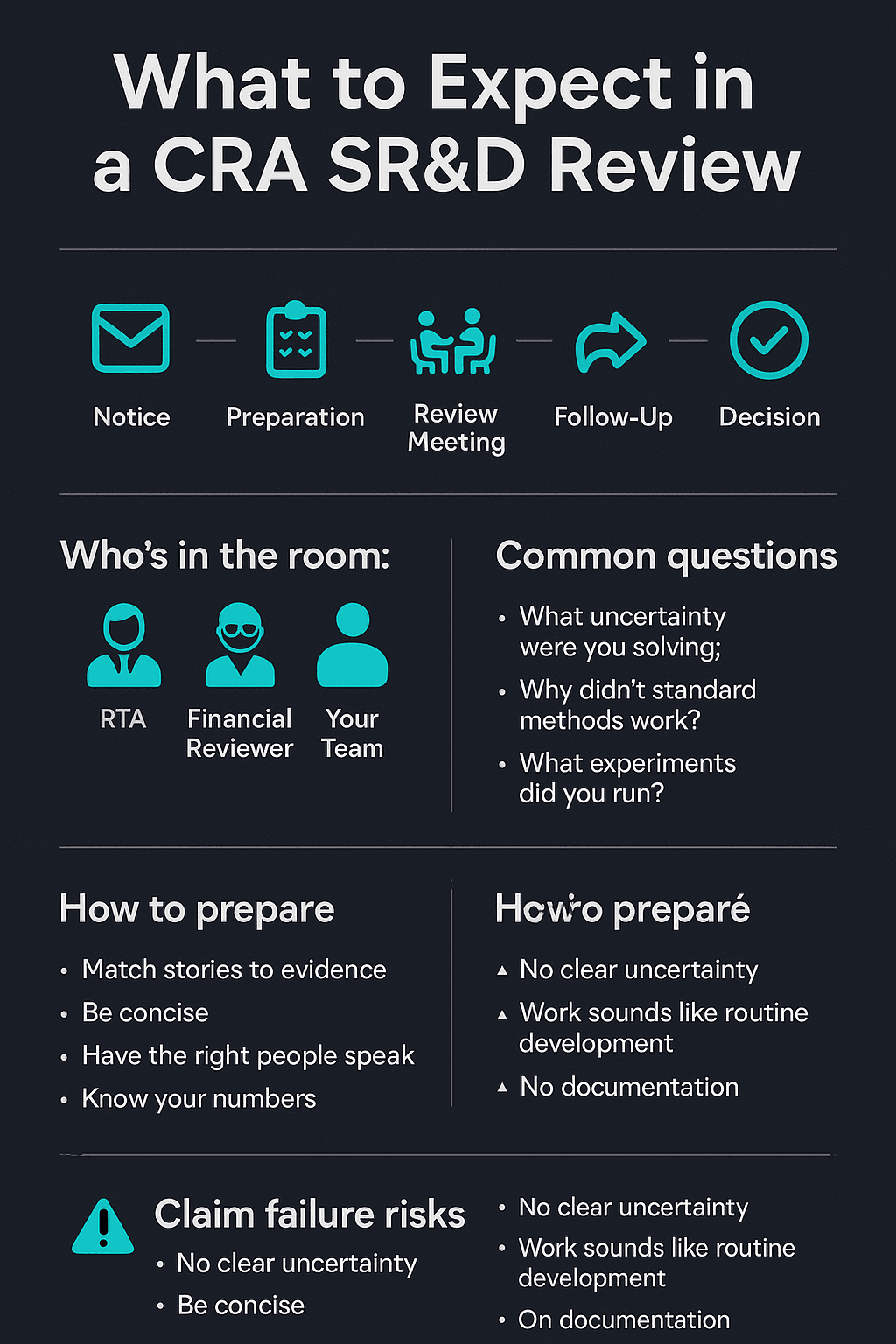
What to Expect in a CRA SR&ED Review & Common Audit Questions
Comprehensive guide to CRA SR&ED reviews including timeline, common questions, and how to prepare for audit success
2025-01-15SmartSRED Team2 min
SR&ED
CRA Review
Audit
Preparation
Tax Credits
What to Expect in a CRA SR&ED Review & Common Audit Questions
It’s not a scary audit — here’s what actually happens in an SR&ED review.
A CRA SR&ED review is essentially an audit to confirm your claim meets the program’s criteria. It’s not about catching you out; it’s about verifying that the work you’ve claimed truly qualifies.
💡 Important: If this is your company’s first SR&ED claim, CRA almost always conducts a review. This is normal and doesn’t mean you’ve done anything wrong.
1. The Notice
You’ll first receive a letter or email from the CRA letting you know your claim has been selected for review. This will include:
- The scope of the review (technical, financial, or both)
- The period under review (fiscal year)
- A list of documents you may need to provide
2. The Timeline
- Initial Contact: Usually within weeks of claim submission
- Preparation Window: 2–4 weeks to gather materials
- Review Meeting: Often 1–3 hours (in person or virtual), sometimes split into technical and financial sessions
- Follow-Up: CRA may request clarifications or extra evidence within 1–2 weeks
- Decision: Most resolved in ~3 months; complex cases can take longer
3. The Review Meeting
Who’s in the room:
- CRA Research and Technology Advisor (RTA) for technical review
- CRA Financial Reviewer for cost verification
- Your team: Technical lead, finance lead, and optionally an SR&ED consultant
What they’ll ask:
- Technical: What uncertainty you were solving, why standard methods didn’t work, and what experiments you ran
- Financial: How salaries, materials, and subcontractor costs were tracked and separated from non-eligible work
4. Common CRA SR&ED Review Questions
Technical Review (RTA)
- What was the technological uncertainty you were trying to solve?
- Why couldn’t you use an existing, standard method or tool?
- What hypotheses did you test?
- Can you walk through the experiments you performed and their results?
- What failures or dead-ends did you encounter, and how did they shape your next steps?
- How is your approach different from what is documented in literature or industry best practices?
- What was your starting point and what advancement did you achieve?
- Can you show evidence such as code commits, lab notes, or design revisions?
Financial Review
- How did you track employee time on eligible vs. non-eligible work?
- Can you provide payroll records for claimed salaries?
- How did you determine overhead allocation?
- Do you have invoices and contracts for subcontractors or freelancers?
- Were any government grants (IRAP, MITACS, etc.) used to fund this work, and how were they offset?
- How did you value materials consumed during R&D?
- Can you separate capital equipment from consumables?
5. How to Prepare
- Match stories to evidence: For every experiment, have code commits, lab notes, or design iterations ready
- Be concise: Focus on technological uncertainties and systematic investigation
- Have the right people speak: Engineers/scientists for technical, finance for numbers
- Know your numbers: Be ready to explain cost breakdowns clearly
6. Common Reasons Claims Fail
- No clear technological uncertainty
- Work sounds like routine development
- No documentation to support the claim
- Over-claiming commercial work