The 5 Mistakes That Kill Your SR&ED Claim and How to Avoid Them
Avoid the most common SR&ED claim mistakes that cost businesses valuable tax credits and learn prevention strategies
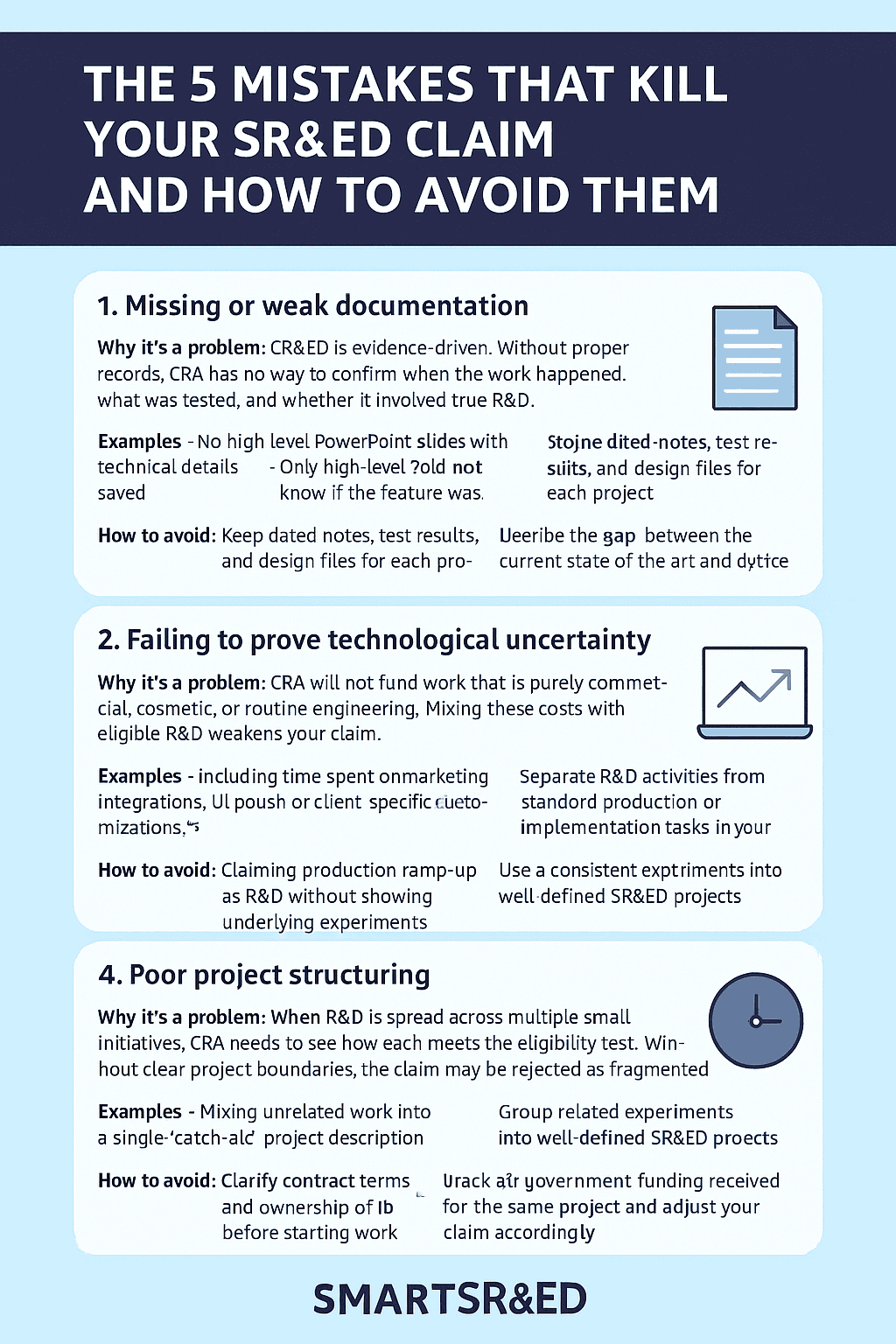
The 5 Mistakes That Kill Your SR&ED Claim and How to Avoid Them
Every year, thousands of Canadian businesses lose out on valuable SR&ED tax credits not because their work was ineligible, but because of avoidable mistakes.
Here are the most common errors we see and how you can avoid them.
1. Missing or weak documentation
Why it is a problem:
SR&ED is evidence-driven. Without proper records, CRA has no way to confirm when the work happened, what was tested, and whether it involved true R&D.
Examples:
- No experiment logs or design iterations saved
- Only high-level PowerPoint slides without technical details
How to avoid:
- Keep dated notes, test results, and design files for each project
- Store evidence in a central location so it is accessible at year-end
2. Failing to prove technological uncertainty
Why it is a problem:
CRA’s three-part test starts with technological uncertainty. If you cannot explain what made the work uncertain from a technical standpoint, your claim will likely be denied.
Examples:
- Stating “We did not know if the feature was possible” without explaining why existing methods would not work
- Confusing business risk such as market demand with technical risk
How to avoid:
- Describe the gap between the current state of the art and your objective
- Show why a competent professional could not solve the problem using existing techniques
3. Misclassifying commercial work as R&D
Why it is a problem:
CRA will not fund work that is purely commercial, cosmetic, or routine engineering. Mixing these costs with eligible R&D weakens your claim.
Examples:
- Including time spent on marketing integrations, UI polish, or client-specific customizations
- Claiming production ramp-up as R&D without showing underlying experiments
How to avoid:
- Separate R&D activities from standard production or implementation tasks in your timesheets
- Only include costs tied directly to resolving technological uncertainty
4. Poor project structuring
Why it is a problem:
When R&D is spread across multiple small initiatives, CRA needs to see how each meets the eligibility test. Without clear project boundaries, the claim may be rejected as fragmented or too vague.
Examples:
- Mixing unrelated work into a single “catch-all” project description
- Failing to link experiments to a central technical objective
How to avoid:
- Group related experiments into well-defined SR&ED projects
- Use a consistent format for documenting uncertainty, hypotheses, tests, and results
5. Overlooking subcontractor and funding rules
Why it is a problem:
If you hire contractors or receive grants such as IRAP or Mitacs, you need to follow specific SR&ED cost rules. Claiming ineligible expenses can trigger audits or clawbacks.
Examples:
- Paying a non-resident contractor without checking if costs are eligible
- Forgetting that grant-funded portions of the work must be subtracted from your claim
How to avoid:
- Clarify contract terms and ownership of IP before starting work
- Track all government funding received for the same project and adjust your claim accordingly
The takeaway
A strong SR&ED claim is built on three things: clear evidence, well-defined technical uncertainty, and proper cost allocation.
By avoiding these five mistakes, you improve your odds of a smooth review and full credit payout.
SREDSimplify helps startups and SMEs track R&D activities in real time, document eligibility, and prepare claims that pass CRA review.
You can try our free pre-screener here: https://sredsimplify.com/
#SRnED #TaxCredits #Innovation #Engineering #StartupSupport #SREDSimplify